Moths
The Lighthouse (Alison Moore Edition)Moths recur throughout the novel as creatures caught between attraction and danger: they fly toward lamps, become prey, are pinned into collections, and sometimes vanish before anyone can understand how they arrived. Their appearances link Futh’s childhood to his unsettled adult journey and to Ester’s private history. The moth’s fragile, misdirected flight becomes a concrete image of the characters’ difficulty finding a way toward safety or intimacy.
Light, Navigation, and Disorientation
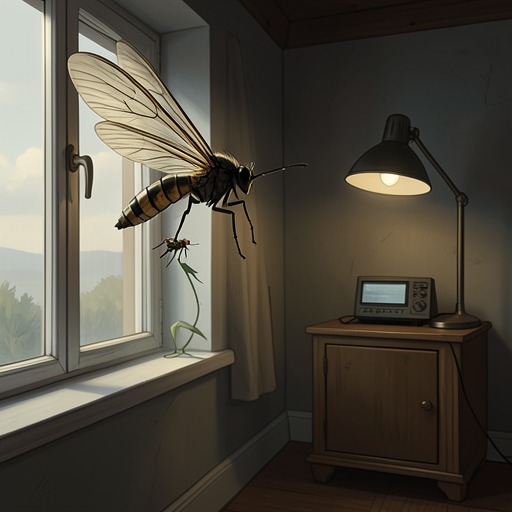
During Futh’s walk, a moth enters his room through the open window while he is eating supper. He considers the pavement far below and wonders whether a fall from that height would break anything. The moment joins his habitual attention to escape routes with a creature’s uncertain passage through the dark: the window offers an exit, but not necessarily a safe one.
Later, unable to concentrate on his book, Futh watches another moth fly at the lamp. He opens the curtains and window to let it out, understanding that it is seeking the moon as a navigational aid, though he cannot see the moon himself. The distinction matters: Futh can recognize the moth’s lost orientation without being able to supply what it needs. The moth moves away from the artificial light toward the open window, then returns from a fold in the curtains and flutters against the hot bulb. Its movement is neither a clean escape nor a simple attraction; it is a repeated, perilous circuit.
The episode parallels Futh’s own distracted attention. His thoughts turn from the moth to home and the failures of his marriage, while his reading yields only repeated lines he cannot absorb. The moth’s apparent inability to follow a reliable course gives physical form to a larger condition of disorientation, without making the creature merely a symbol: it remains a small animal responding to different sources of light.
The Moth in Gloria’s Kitchen
A childhood moth appears in a more violent tableau when Futh visits Gloria’s house. On the kitchen windowsill, a Venus flytrap has closed around one. Futh had been looking at the plant and had only briefly looked away; by the time he looks back, the moth is already caught. He wonders how it happened and feels sorry to have missed the moment itself. Gloria explains that the trap will reopen in a week or so and that what remains will blow away.
The scene makes capture visible only after it has occurred. Futh can see legs and the edges of wings between the plant’s closed leaves, but not the instant when the trap took its prey. That gap between event and recognition returns in his later memory of the kitchen: as an adult visiting Japan, he sees sea creatures wrapped in clingfilm in supermarket refrigerators, still moving their legs uselessly, and recalls the moth trapped in Gloria’s plant. In both images, movement persists inside a confinement that offers no apparent route out.
While Futh watches the trapped moth, Gloria touches the back of his neck and traces a line beneath his T-shirt. His attention remains fixed on the plant and on the moth’s struggle; only afterward does he realize that Gloria has stopped touching him and may have stopped some time before. The juxtaposition gives the moth episode a place in a memory of uncertain bodily boundaries as well as of missed action. The creature is caught in plain sight, but Futh’s attention cannot fully grasp either what has happened to it or what is happening to him.
Ester’s Collection and the Museum
Moths also belong to Ester’s history of collecting. As a girl, she visits the Museum für Naturkunde in Berlin and is both disturbed and fascinated by its preserved specimens: fish and invertebrates in alcohol, stuffed mammals, and butterflies and moths pinned to display boards. A few days later, a moth flies through her open bedroom window toward the lightbulb while she reads a romantic photo story. She catches it between her palms and pins it to the corkboard in her room. It becomes the first specimen in her collection, the first of several collections that Bernard later disparages as hoarding.
Her memory emphasizes touch as much as display: she still recalls the tickle of the moth’s powdery wings trapped between her palms. The live creature’s brief movement is converted into a still specimen, just as the museum’s extensive collections make living forms available to the gaze by preserving them. Ester’s small private collection begins with that transformation from flight to capture. The moth is not only an item kept; it is the remembered sensation of a body moving against her hands.
Years later, Ester’s hotel has ten bedrooms, though only a few are usually occupied and some remain empty for entire seasons. After she leaves a bathroom light on and its window open for weeks, she returns to find the white glass shade full of moths. The neglected room has become an accidental trap, its light drawing creatures into an enclosed space. This episode echoes the moth’s attraction to Futh’s lamp, but changes the scale: the individual encounter becomes a mass accumulation unnoticed over time.
Preserved Wings and Recalled Spaces
When Futh enters Ester’s private rooms looking for his silver lighthouse, moths appear among her personal effects. In a jewellery box he first mistakes a pinned moth for a brooch. He touches its stilled wings before closing the drawer. The error briefly turns a preserved creature into an ornament, while his touch confirms the stillness that distinguishes it from the moths beating against lamps. Nearby, worn lipsticks, necklaces, and other keepsakes locate the specimen within Ester’s intimate, accumulated belongings rather than in a formal display.
The moth also belongs to Futh’s remembered maternal spaces, though there it appears indirectly in the mothballs his mother uses in summer. He imagines the dark wardrobe where he made a nest among her shoes, with woollen skirts brushing his face and the smells of leather, cigarette smoke, and camphor around him. He would have liked to bottle that private atmosphere as Essence of Mother, but instead he has the scents of violets and oranges. Much later, the smell of camphor from a bottle in Ester’s bathroom carries him back to the wardrobe with such force that it feels like being wrenched through time. Moths are not the source of this memory, but mothballs mark one of its characteristic smells: the wardrobe’s protection against insects is inseparable from the enclosed space in which Futh sought the presence of his mother.
Recurrence and Significance
The recurring moth changes form from scene to scene: a visitor at a hotel window, an insect circling a lamp, prey hidden in a plant, a specimen pinned in Ester’s room, and a swarm gathered in an empty bathroom. These are distinct circumstances, not a single allegory. Together, however, they establish a pattern of attraction followed by danger, confinement, or disappearance. The moth seeks light but cannot reliably distinguish a navigational aid from a hot bulb; human observers likewise notice crucial things late, or mistake what they see.
The pattern’s force lies partly in its interruptions. Futh is sorry to have missed the capture in Gloria’s kitchen; Ester’s girlhood collection begins when a living moth becomes something pinned; and Futh discovers a preserved moth while searching for an object he hopes to recover. Each encounter asks what can be retained once movement has stopped, and what remains beyond the observer’s knowledge. The moths give the novel a recurring, physical measure of fragile life moving through spaces that attract, preserve, or entrap it.